

‘Advancing digital sovereignty’ with Tribal Broadband Bootcamps

Kalle Benallie
ICT
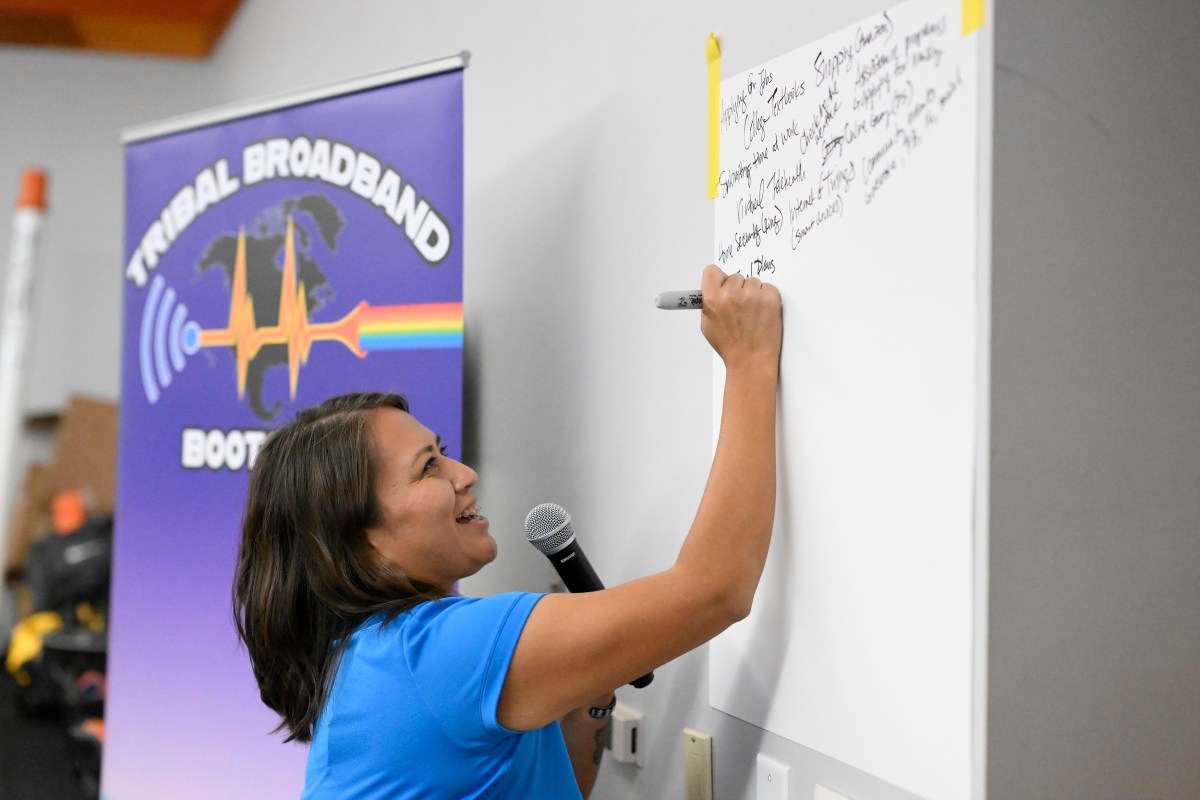
Davida Delmar jokingly says during a few days into her instruction at a Tribal Broadband Bootcamp that she’s a really good fiber splicer, which is the act of joining two optical fibers end-to-end, and it’s due to her experience in beadwork. She asks who else is a beader.
More often than not a woman answers, Delmar said, who is Navajo.
“This is like kind of one instance that I definitely do almost every boot camp because I want to encourage women that this space is for you, despite being a male dominated field that I see more and more women, especially in tribal ISPs (Internet Service Providers), taking the reins and entering the work,” she said.
Delmar has attended 16 Tribal Broadband Bootcamps, mostly as an instructor but first attended to learn about fiber. She said she’s seen a lot of women heading tribal networks.
It’s a space that tribes are trying to break through, and it hasn’t been easy.
It was Matt Rantanen, Cree descendant, that saw the lack of opportunities for tribes and co-founded with Chris Mitchell, an engaging, non-judgemental learning environment called the Tribal Broadband Bootcamp.
“In a lot of cases Indian Country comes into a space not knowing the information. In the environment that you get in conferences and stuff, you’re sitting around a bunch of experts and they’re kind of snobby about it. We don’t operate that way,” he said. “We feel like everybody has something to learn, but everybody has something to contribute as well even at the most basic level.”
The Federal Communications Commission said in a recent report that approximately 24 percent of Americans living on tribal lands lack broadband access, comparatively to about 7 percent of Americans broadly.
Federal funding for the tribal broadband didn’t have its own program until 2021, called the Tribal Broadband Connectivity Program, with $3 billion from the American Rescue Plan and the Infrastructure Investment and Jobs Act.
The Tribal Broadband Bootcamp jumpstarted from the connectivity program’s application window coinciding with another FCC priority window for tribes in rural areas to have exclusive access to 2.5 gigahertz (needed for Wi-Fi and can penetrate through walls) over their tribal lands in 2021. The COVID-19 lockdown stalled progress with tribes receiving their tribal priority license and having few communication with the National Telecommunications and Information Administration.
Requests for information, training and awareness on broadband surged. Many reached out to Rantanen because of his job with the National Congress of American Indians and other projects he’s been involved in. He is co-chair of NCAI’s technology and telecom subcommittee and co-chair of their technology task force.
Rantanen is also the director of technology for the Southern California Tribal Chairmen’s Association and director of the Tribal Digital Village Network/Initiative.
“We had some direct outreach from tribes and coming up with an idea of ‘how can we assist folks that need the support on their reservation?’ Their reservations are still closed because we can’t spread COVID. So we’re like how are we going to do this?” Rantanen said.
It was Mitchell and a bootcamp trainer that came up with the idea to have it on Rantanen’s 24-acre property in Southern California.
“Like good scientists that we are, we said, well, this might have been a fluke. We probably better try to do it again to prove that it was actually a success, and not just a one off. So let’s do another one,” he said.


Ernie Rasmussen, executive director at Colville Bigfoot network, a tribal telecommunications, first went to a tribal broadband bootcamp three years ago to observe what it was about.
There have been nearly 20 bootcamps across the U.S. since then and over 400 people from more than 80 tribes have trained at the bootcamp. There are approximately 80 tribal broadband networks, which are internet networks owned by tribal nations, according to the Institute of Local Self-Reliance.
“When I went and what I saw was something that I thought there’s a good opportunity. I asked Matt if they were open to some feedback, and they said sure. I offered some very candid feedback,” Ramussen, Oneida Nation of Wisconsin, said.
The feedback was to bring in more Indigenous experts and professionals. He was asked if he could be an instructor.
“I spend a lot of time talking about the sustainability of tribal networks. These are new networks that are being freshly constructed, newly deployed. How do we actually strike a balance that allows for affordable service, yet you have some revenues in reserve to be able to ensure that you’re sustainable and your operations will continue for multiple generations.”
Rasmussen added the bootcamp has evolved from training frontline workers to discussing a range of issues like protecting elders from cybersecurity threats and the community from online predators and how to approach tribal councils to create policies that protect them.
“It has a good breadth of conversations, and then depending on the community that’s going to be there, you have some flexibility and depth,” he said.
Rasmussen said he hopes in the future that participants can come away from the bootcamp with certifications in splicing fiber or any other skill.
“I know that that’s going to take time but that’s been something I’ve always asked of Matt and the team to begin to think about what that would look like,” he said. “I can’t say that I would expect that out of him this year, but I’m hoping that as they continue to grow and evolve that we get to that.”
There are workshops designed for attendees to learn how to build and maintain their own broadband infrastructure. There’s peer-to-peer learning with participants able to share challenges, strategies and successes from their own broadband development efforts.

The Sault Ste. Marie Tribe of Chippewa Indians hosted the bootcamp in the Upper Peninsula of Michigan from Aug. 18 to Aug. 21 with more than 10 tribes represented. They provided training in both wireless and fiber optic network technologies like seeing a live demonstration of a builder putting fiber on the ground.
Dan Doyle, chief executive officer enterprise operations, Sault Ste. Tribe of Chippewa Indians, said in a press release they are building their own broadband network and are honored to be part of the bootcamp.
“Together, we are advancing digital sovereignty for our people, now and for generations to come,” Doyle said.
The next bootcamp will be Nov. 3rd from Nov. 6 in Aguanga, California, at the RantanenTown Ranch where there is a “broadband playground” that has fiber in the ground, access points, splice points, volts, a tower and an aerial demonstration.
“We just kind of leave that stuff up on the property so people can get access to it and mess around with it. We tend to have a little bit better attendance at these events because they get to play with stuff that’s tangible,” he said.
Rantanen said they really try to have various tribes be part of one bootcamp event because they can develop new solutions from learning about each other’s different environments.
“We’re trying to get around to the regions of where the tribes are so that they have access locally, and to showcase those wonderful projects that are happening throughout Indian Country,” Rantanen said.
Rantanen said tribes and participants get connected with the bootcamp through word of mouth and through a forum to indicate interest level.
“It’s a big community. It is Indian Country, but it’s tech geek Indian Country if you will,” he said.
Then some of those who attended want to bring it to their tribal communities.
Jason Younker, a chief of the Coquille Tribe, coordinated with the University of Oregon to co-host a bootcamp with the Burns Paiute Tribe in August 2022 so it could be in a bigger venue. Younker is also an assistant to the University of Oregon’s vice president and adviser to the president on sovereignty and government to government relations.
Rantanen said in partnering with a tribe the bootcamp tries to do local catering, use their venues and work with cultural people for participants to learn more about the culture of the location they’re in.
Abraham Camez III, Yaqui descendant, has participated in two bootcamps and a miniature one at a Net Inclusion conference. He’s presented about digital inclusion and digital equity, discussing digital literacy, devices and security.
Camez said that many tribes wanting to host and go to events shows the need for tribal leadership to learn more about the process and show their progress in fiber builds.
“It’s been my experience working within [the] Hoopa Valley Tribe for nearly 20 years that other tribes will/are willing to share their experiences, whether good or bad, so the same mistakes are not made. There is no sense in reinventing the wheel,” he said.
Rantanen said he thinks the billion dollar federal government investment as a one-time investment so it’s very important to learn from tribes that have built broadband.
He ultimately wants tribes to make their own decisions and have a variety of opportunities to choose what fits them best.
“My goal with this is really to see 500+ tribal owned and operated or tribal managed networks. That may be an outside vendor builds the network, but the tribe manages the outside vendor and owns the assets,” Rantanen said.
The next possible tribal collaboration is with the Seminole Tribe of Florida next year.
The host community, regional participants’ and participating tribes’ experiences and interests are integrated in the bootcamp’s curriculum. Full travel and lodging support is also available. All meals during the bootcamp are covered. The bootcamps are open to tribal leaders or community members wanting to learn more.
This story has been corrected to correctly spell Jason Younker’s last name.
Kalle Benallie, Navajo, is a Multimedia Journalist, based out of ICT’s Southwest Bureau. Have any stories ideas, reach out to her at kalle@ictnews.org. More by Kalle Benallie
Original article can be found here at ICT: ‘Advancing digital sovereignty’ with Tribal Broadband Bootcamps – ICT